
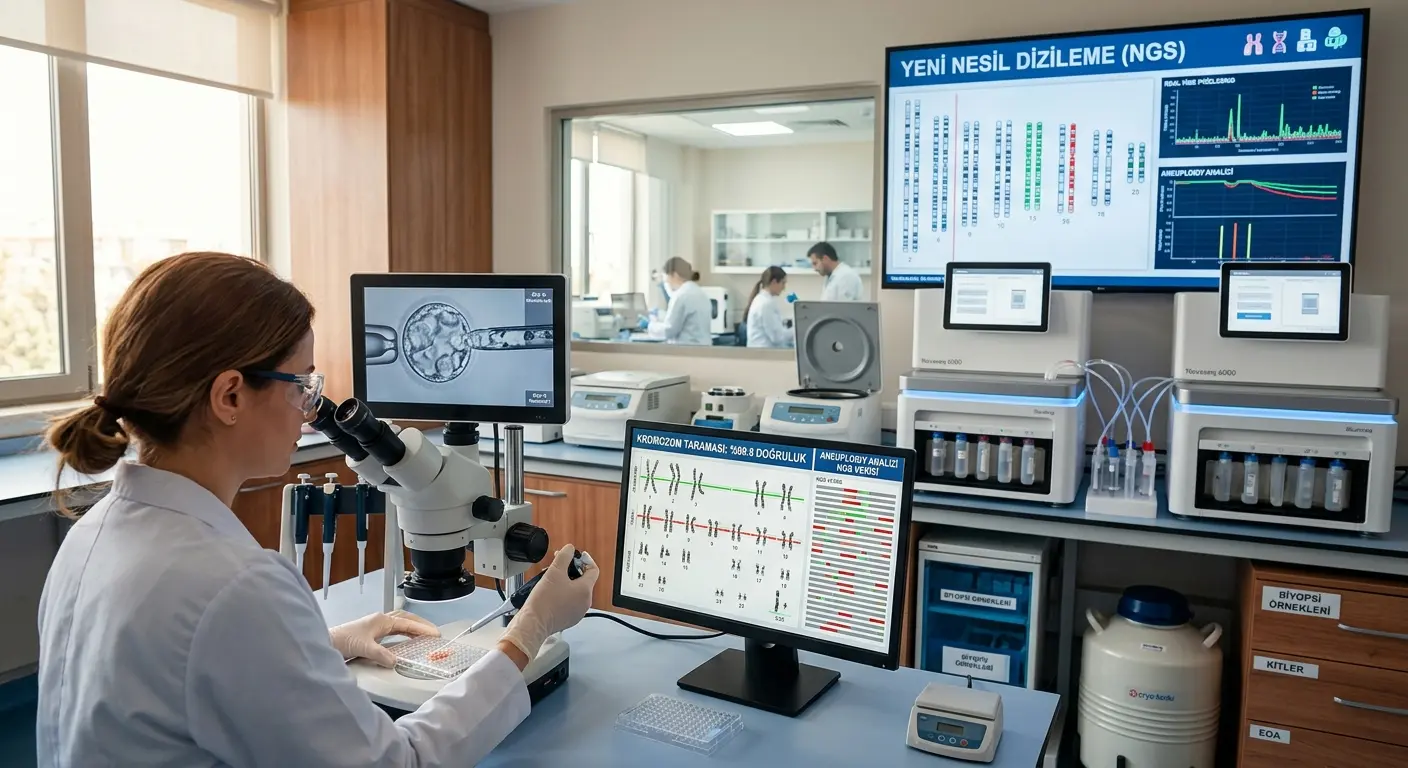
NGS (Next Generation Sequencing): Advanced Genomic Testing in IVF Treatment
Inside a single cell, invisible to the naked eye, approximately 3.2 billion base pairs are arranged in sequence. This arrangement largely determines who you are, how you look, which diseases you’re predisposed to, and whether you can develop successfully as an embryo. For years, reading this sequence was an expensive and laborious process reserved only for major research centers. Today, all of this information is accessible through a single embryo test.
NGS — Next Generation Sequencing — is the name of the technology that has brought this capability into IVF treatment.
In this article, we explain what NGS is, how it works, who it’s recommended for, and what its risks and benefits are — in language everyone can understand.
What Is NGS? Core Definition and Conceptual Framework
NGS (Next Generation Sequencing) is an advanced biomedical technique that analyzes millions of DNA fragments simultaneously, reading the entire genome or specific regions with high precision.
Here’s what sets it apart from older genetic tests: traditional methods read DNA sequentially, one segment at a time — like reading a book word by word. NGS, by contrast, works as if you distributed the same book to hundreds of people simultaneously, had them all read it at once, and then reassembled it like a puzzle. This parallel reading capacity dramatically increases both speed and accuracy.
In IVF, NGS is used specifically within the framework of Preimplantation Genetic Testing (PGT). The goal is to examine an embryo’s genetic makeup before it is transferred to the uterus — identifying embryos with chromosomal abnormalities or specific genetic disease carriers, and selecting the healthiest embryo to maximize the chances of a successful pregnancy.
To fully understand NGS, several foundational concepts are essential:
- Genome: The complete DNA set containing all of an organism’s genetic information.
- Chromosome: The structure in which DNA is tightly packaged. Humans normally have 46 chromosomes (23 pairs).
- Aneuploidy: A condition in which a cell contains an abnormal number of chromosomes — either too many or too few. Down syndrome, for example, results from having three copies of chromosome 21 (trisomy 21).
- Biopsy: An embryo biopsy involves removing a small number of cells from an embryo before it is implanted in the uterus.
- PGT (Preimplantation Genetic Testing): The general term for genetic screening protocols applied to embryos prior to transfer.
- SNP (Single Nucleotide Polymorphism): A variation at a single nucleotide position in a DNA sequence. NGS detects these variations with high sensitivity.
The Historical Development of NGS: The Birth of a Technology
The integration of genetic testing into IVF dates back to the early 1990s, with the introduction of FISH (Fluorescence In Situ Hybridization). FISH used fluorescent dyes to label and visualize specific chromosomal regions, but could only examine a limited number of chromosomes at a time.
In the mid-2000s, CGH (Comparative Genomic Hybridization) and later aCGH (Array CGH) emerged. These methods could analyze all 24 chromosomes (22 autosomal + X and Y), but still missed certain mosaic conditions and small genetic abnormalities.
NGS began to gain widespread adoption in the 2010s and is now recognized as the gold standard. It surpasses its predecessors not only by analyzing all 24 chromosomes, but by detecting specific genes and even single nucleotide variations (SNPs) — capabilities well beyond what earlier technologies offered.
How Does NGS Work? Step-by-Step
1. Embryo Biopsy
After fertilization takes place during IVF, the embryo begins to develop. The most common stage for NGS analysis is the blastocyst stage — typically day 5 or 6. At this point, the embryo consists of two distinct cell groups: the trophectoderm (which will form the placenta and membranes) and the inner cell mass (which will become the baby).
The biopsy is performed by removing 5–10 cells from the trophectoderm region. Since these cells will not form the baby itself, the procedure does not harm the embryo. It is carried out by an experienced embryologist using advanced laser technology and glass micropipettes.
After the biopsy, embryos are preserved using vitrification — an ultra-rapid freezing technique — while awaiting genetic analysis results.
2. DNA Amplification (WGA — Whole Genome Amplification)
The amount of DNA in a biopsy sample of just a few cells is extremely small. For NGS analysis to be performed, this DNA must be copied millions of times. This process is called Whole Genome Amplification (WGA).
Using specialized enzymes, copies are produced from the original DNA template. Amplification errors are kept to an absolute minimum, as a single error can compromise the entire analysis.
3. Library Preparation
After amplification, the DNA is fragmented into small pieces, and short DNA sequences called adapters are attached to each fragment’s ends. These adapters allow the DNA fragments to bind to the sequencing device and be reassembled afterward. This step is called “library preparation” — because the resulting collection of labeled, organized DNA fragments resembles a well-catalogued library.
4. Massively Parallel Sequencing
The prepared library is loaded into the NGS device, which reads all DNA fragments simultaneously — in parallel. Each individual read is called a “read.” Modern NGS instruments can generate billions of reads in a single run.
Each read is aligned against a reference human genome to determine where in the genome each DNA fragment belongs. This process is carried out using bioinformatics algorithms, ultimately calculating how many copies of each chromosome are present and whether any abnormalities exist.
5. Analysis and Reporting
NGS analysis can detect copy number variations (CNVs), mosaic abnormalities, deletions, duplications, and translocations. Results are evaluated by a team of geneticists and embryology specialists, and a detailed report is prepared for each embryo.
Reports are typically categorized as follows:
- Euploid: All chromosomes are present in normal numbers — suitable for transfer.
- Aneuploid: One or more chromosomes show abnormalities — transfer not recommended.
- Mosaic: Some cells are normal, others are abnormal — requires specialized evaluation.
What Is the Relationship Between PGT and NGS?
NGS is the technology; PGT is the name of the clinical application that uses it. In medical literature, PGT is divided into three subcategories based on clinical indication:
PGT-A (Aneuploidy Screening)
The goal is to identify aneuploid embryos — those with an incorrect chromosome count — before transfer. All 24 chromosomes are screened. This test is especially recommended for patients with unexplained recurrent pregnancy loss, advanced maternal age, or multiple failed IVF attempts.
PGT-M (Monogenic Diseases)
Used to investigate single-gene (monogenic) disorders. Embryos are screened using a custom-designed test panel targeting specific genetic conditions such as cystic fibrosis, Tay-Sachs disease, sickle cell anemia, and Huntington’s disease. This test significantly reduces the risk of transferring an embryo affected by the condition in carrier or affected couples.
PGT-SR (Structural Rearrangements)
When one parent carries a chromosomal translocation, inversion, or other structural rearrangement, this test determines whether embryos have inherited the anomaly. Structural rearrangement transfer is a significant cause of recurrent pregnancy loss in balanced translocation carriers.
Comparing NGS with Previous-Generation Tests
| Feature | FISH | aCGH | NGS |
|---|---|---|---|
| Chromosomes analyzed | 5–9 | 24 | 24 + single-gene analysis |
| Resolution | Low | Moderate | High |
| Mosaic detection | Weak | Limited | Strong |
| SNP analysis | No | Partial | Yes |
| Error rate | Higher | Moderate | Low |
| Clinical status | Legacy | Widely used | Gold standard |
Who Is NGS Recommended For?
The application of NGS depends on the clinician’s assessment and the couple’s medical history. However, it is generally prioritized in the following situations:
Advanced Maternal Age (≥35)
As a woman ages, the error rate during meiotic cell division increases. These errors — caused by non-disjunction during meiosis — result in eggs with extra or missing chromosomes. The rate of aneuploid embryos in a 35-year-old woman is approximately 40–50%; by age 42, this figure can exceed 80%. NGS identifies euploid embryos and places transfer selection on objective grounds.
Recurrent Pregnancy Loss (Habitual Abortion)
In couples who have experienced two or more consecutive clinical pregnancy losses, it is known that 50–60% of these losses stem from chromosomal abnormalities in the embryo. When euploid embryos are transferred following NGS testing, the rate of recurrent loss is significantly reduced.
Failed IVF Attempts
When two or more implantation failures have occurred despite the transfer of good-quality embryos, visual assessment alone has proven insufficient for evaluating embryo quality. NGS can eliminate the “healthy-looking but non-implanting embryo” problem by identifying embryos that appear morphologically normal but are genetically aneuploid.
Known Genetic Disease Carrier Status
If one or both partners carry a known genetic condition or have tested positive for genetic carrier status, NGS can be used under PGT-M to determine whether the embryo has inherited the disorder.
Chromosomal Structural Anomaly
When one parent carries a balanced chromosomal translocation, inversion, or other structural rearrangement, NGS is applied under PGT-SR.
Unexplained Infertility
In couples for whom no cause has been identified through standard infertility evaluation, the genetic quality of embryos may be a relevant consideration. NGS can help guide treatment by identifying euploid embryos.
NGS and Pregnancy Success: Clinical Evidence
The published literature on the clinical effectiveness of NGS is substantial.
A comprehensive meta-analysis published in 2020 compared IVF cycles with and without PGT-A, demonstrating that cumulative live birth rates were significantly higher in the PGT-A group, particularly among women of advanced maternal age. The same study showed an improvement in pregnancy rate per embryo transferred — meaning more success with fewer transfer cycles.
The European Society of Human Reproduction and Embryology (ESHRE) supports the use of PGT-A/NGS in patients with advanced maternal age and recurrent implantation failure. The American Society for Reproductive Medicine (ASRM) similarly recommends PGT-A in selected patient populations.
That said, several important nuances exist:
- In young patients with a good prognosis (younger age, adequate ovarian reserve, normal genetic profile), whether NGS provides additional benefit remains debated.
- If all embryos are found to be aneuploid, an unexpected situation arises in which no embryo is available for transfer.
- The question of mosaic embryo transfer remains an area of active clinical discussion requiring independent expert evaluation.
Mosaic Embryos: The Gray Zone
The most clinically debated NGS finding is mosaicism. A mosaic embryo has a mixed genetic profile — some cells are normal (euploid) while others are aneuploid.
Clinical approaches to mosaic embryo transfer vary between centers, but current data indicate that embryos with low mosaicism rates (<20%) may be considered for transfer with careful patient selection and genetic counseling. There is also emerging evidence that some mosaic embryos may self-correct as they develop — meaning aneuploid cells may be selectively eliminated, allowing the euploid cell population to predominate — though this process varies from embryo to embryo and is difficult to predict.
When mosaic embryo transfer is under consideration:
- High mosaicism rates (>50%) are not recommended for transfer.
- The specific chromosome affected also matters; mosaicism in certain chromosomes may carry less clinical significance.
- Prenatal diagnosis (amniocentesis or chorionic villus sampling) is strongly recommended in pregnancies resulting from mosaic embryo transfers.
Limitations of NGS: What You Need to Know
Like all technologies, NGS has certain limitations. Being aware of these protects against unrealistic expectations.
1. False Negative and False Positive Results
Although NGS has an accuracy rate above 95%, no test is 100% perfect. Amplification errors, biopsy quality issues, or technical factors can, on rare occasions, produce inaccurate results. For this reason, prenatal confirmation testing is recommended for specific genetic conditions identified through PGT-M.
2. Cannot Detect All Genetic Conditions
In its current form, NGS does not guarantee a healthy birth. Epigenetic factors, certain single nucleotide polymorphisms, environmentally triggered conditions, and as-yet-uncharacterized genetic variants all fall outside the scope of NGS detection.
3. The Biopsy May Not Fully Represent the Embryo
The 5–10 cells taken from the blastocyst trophectoderm must represent the entire embryo. In cases where different regions of the embryo have different genetic compositions — i.e., mosaicism — this small biopsy sample may not fully reflect the complete picture.
4. All Embryos May Become Ineligible for Transfer
It is possible that PGT-A results show no euploid embryos at all. This outcome can be emotionally devastating for couples. This possibility should be addressed in genetic counseling before treatment begins, ensuring couples are mentally prepared.
5. Cost
NGS-based PGT testing adds cost to standard IVF treatment. Since each embryo must be analyzed individually, total costs rise proportionally with the number of embryos obtained.
The Patient Experience During NGS: What to Expect
Many patients are uncertain about when, how, and why NGS testing is performed. Here is a step-by-step overview of the process:
- Genetic Counseling: Before treatment begins, the couple meets with a genetic counselor or reproductive endocrinologist. Family history, carrier testing, and the appropriate PGT protocol are established at this stage.
- Ovarian Stimulation and Egg Retrieval: The standard IVF protocol is followed. Hormonal therapy stimulates the development of multiple eggs, and egg retrieval (OPU — Oocyte Pick-Up) is performed under ultrasound guidance.
- Fertilization and Embryo Culture: Retrieved eggs are fertilized with sperm in the laboratory. Embryos are monitored in specialized incubators for 5–6 days.
- Blastocyst Biopsy: Trophectoderm biopsy is performed on embryos that reach the blastocyst stage. This procedure is carried out in the embryology laboratory with precision measured in thousandths of a millimeter.
- Vitrification: Biopsied embryos are immediately frozen and stored. No embryo is transferred fresh, as analysis results may take several days.
- Genetic Analysis: Biopsy samples are sent to the NGS platform. Analysis typically takes 7–14 days.
- Result Evaluation and Transfer Planning: Once euploid embryo(s) are identified, a Frozen Embryo Transfer (FET) is planned in alignment with the following menstrual cycle. An endometrial preparation protocol is applied, and the transfer is performed.
NGS and the Psychological Dimension: Is Knowing Always Better?
Have you ever asked yourself this question? Through NGS, you can access the genetic map of your embryos. But is this information always reassuring?
For some couples, learning that all embryos are aneuploid is the most devastating outcome of treatment. This moment carries not just medical information, but a profound sense of grief. For some, being able to proceed with a “transfer of hope” — even without certainty of success — may feel emotionally easier than learning from the outset that the odds are unfavorable regardless of which embryo is chosen.
On the other hand, avoiding the selection of an aneuploid embryo — and thereby reducing the risk of miscarriage or a baby born with a genetic condition — offers immense psychological reassurance for many couples.
There is no easy resolution to this tension, and there is no universally right or wrong answer. What matters is that the decision is made within a framework of information, counseling, and personal values. At Ivox IVF Center, we treat genetic counseling as an inseparable part of this conversation.
The Role of Genetic Counseling: Testing Is Not the Same as Deciding
NGS results provide you with information — but to interpret that information, evaluate your alternatives, and build the right decision-making framework for your specific situation, expert guidance is essential. Genetic counseling is the most critical link in this process.
Topics addressed in a genetic counseling session include:
- Your family’s genetic history
- Which type of PGT is appropriate for you (PGT-A, PGT-M, PGT-SR)
- Carrier screening tests before testing begins
- Possible outcomes and the path forward in each scenario
- Options in the event of a mosaic embryo result
- What to do if all embryos are found to be aneuploid
- Prenatal diagnostic requirements
- Emotional and psychological support resources
Post-NGS Transfer: Frozen Embryo Transfer (FET)
Embryos that have undergone NGS analysis are always stored frozen. For this reason, transfer following NGS is always performed via a Frozen Embryo Transfer (FET) protocol, never as a fresh transfer.
Endometrial preparation is critical for FET success. The uterine lining must be made receptive to progesterone, and the transfer must occur within the optimal window known as the “implantation window.” Some centers may also recommend ERA (Endometrial Receptivity Analysis) testing to further refine this timing.
A typical FET cycle involves the following steps:
- Endometrial preparation with estrogen supplementation
- Ultrasound monitoring of endometrial thickness and morphology
- Transition to progesterone support
- Embryo transfer
- Pregnancy test (beta-hCG) two weeks later
NGS at Ivox IVF Center
At Ivox IVF Center, we recognize that every couple’s genetic risk profile and expectations are unique. For this reason, the decision to pursue NGS is never based on a standardized protocol — it is made through individualized assessment and multidisciplinary team consultation.
The principles guiding our NGS protocol include:
- Comprehensive genetic evaluation: A detailed genetic assessment of both partners is completed before IVF treatment begins.
- Transparent communication: Possible outcomes, limitations, and alternatives are shared openly and honestly.
- Accredited reference laboratories: All NGS analyses are conducted at internationally accredited laboratories with robust internal quality control mechanisms.
- Mosaic embryo management: Mosaic results are evaluated in light of current literature and within an independent ethical review framework.
- Prenatal follow-up recommendation: We work in coordination with the obstetric team following a positive transfer to ensure timely prenatal testing.
NGS: Where Hope Meets Science
IVF treatment is an extraordinary personal journey undertaken to overcome a biological barrier. Every decision along this path — every embryo, every transfer, every waiting period — carries significant emotional weight.
NGS does not eliminate that weight. But it makes the invisible visible; it reduces genetic uncertainty to a great degree; and it makes it possible to proceed to transfer with the embryo carrying the highest potential for success.
An embryo is a remarkable possibility built from 3.2 billion base pairs. NGS is the most advanced tool available to help you evaluate that possibility — but it is most meaningful when used in the right hands, for the right indication, and with the right expectations.
If you would like to learn more about NGS, find out whether your situation makes you a suitable candidate, or begin planning your treatment, you are welcome to contact the specialists at Ivox IVF Center.
This content is for informational purposes only and does not substitute for individualized medical advice. Every patient’s situation is different; all treatment decisions must be made in consultation with a qualified physician.
Frequently Asked Questions About NGS
Does NGS testing harm the embryo?
No. The biopsy is performed on the trophectoderm layer — the cells that will later form the placenta and membranes, not the baby. Large randomized controlled trials have shown no significant difference in obstetric outcomes between pregnancies from biopsied embryos and those from non-biopsied embryos.
Are all embryos suitable for biopsy?
No. Embryos that do not reach the blastocyst stage, or that show poor morphology at this stage, may be technically difficult or impossible to biopsy. Each embryo is assessed individually.
How reliable are the results?
NGS accuracy is reported to be between 95–98%. However, this is not an absolute guarantee. Prenatal diagnostic testing remains the gold standard — and continues to be recommended — particularly for specific genetic conditions identified through PGT-M.
Does NGS guarantee a healthy baby?
Absolutely not. NGS detects only chromosomal and certain genetic abnormalities. Numerous other factors influence whether an embryo results in a healthy birth — implantation capacity, epigenetic regulation, maternal health, and environmental influences among them. NGS does not control for these variables.
Should NGS be recommended for all IVF patients?
No universal recommendation exists. In young patients with good ovarian reserve and a favorable prognosis, the incremental benefit of NGS remains debated. The greatest benefit is seen in patients with advanced maternal age, recurrent implantation failure, recurrent pregnancy loss, and known genetic disease carrier status.
I have only one embryo and NGS has been recommended. What should I do?
This requires an individualized evaluation through genetic counseling. In the presence of a single embryo, NGS provides valuable information about whether that embryo is euploid. However, if the embryo is found to be aneuploid, it cannot be transferred and a new cycle may be necessary. These alternatives should be discussed in detail, and the decision made on a case-by-case basis.